
Membership and Merit
Can social citizenship tame the abuse of advantage?

It took me a while to understand why Michael Sandel chose to use the term tyranny for his 2020 book, The Tyranny of Merit. In this space, I have similarly criticized the excessive reliance on market mechanisms and the hyper-individualism that comes with that, but I have cast these issues as pathologies of liberalism.1 What Sandel is saying is that we have chosen to be ruled by the principle of merit to the exclusion and detriment of other deeply held values. This, he concludes, “makes solidarity an almost impossible project.”2 In contrast, my use of the term pathology implies that the basic mechanisms of market capitalism are sound, as are the core principles of liberalism, but these are prone to excesses that can be managed.
It will take me two weeks to unpack this seemingly minor terminological conflict because the critique of merit runs at two levels. Today, I want to talk about the practical problems associated with measuring and rewarding merit, and the social costs of getting these things wrong. Next week, I will talk about the deeper question of solidarity. It seems necessary to rely on something other than liberalism to hold society together, but what?
The Problem with “Meritocracy”
Sandel isn’t against merit. It is clearly the best way to allocate positions and rewards in society. The main alternatives—aristocracy, nepotism, autocracy—are all obviously worse, whether the standard is fairness or efficiency. It is not the principle that rankles but how it is applied.
There are two core problems with how we apply the merit principle. First, merit is confounded with advantage. The better part of what we perceive as merit reflects the advantages of birth, to having good parents, or, better yet, good and rich parents, to good genes and good health. For a lot of ordinary economic interactions, this is not problematic. We want the best, most qualified, person for the job, and look at certifications or degrees, or at past performance and success as evidence. The fact that these markers of merit reflect earlier advantages does not affect how we should perceive those qualifications. But there are times, especially when we are providing opportunities to young people, when we need to do more to control for relative advantage in our evaluations. I’ll return to that thought in a moment.
Second, and more seriously, we assign moral worth to merit. A person’s qualifications become markers of virtues like dedication, tenacity, and hard work as well as of intrinsic assets like intelligence. We certainly do demonstrate our character through our track record, it is the only way we can demonstrate it, but this means we often believe a person who simply had an easier row to hoe is a better farmer or, worse, a better person.
It is this moral dimension that causes the real damage, because it justifies excessive returns to merit in our society. To an unnecessary extent, rewards in American society are allocated disproportionately relative to merit in a nearly winner-take-all fashion. As Sandel writes, the system “legitimates inequalities that arise from merit rather than birth” and allows those winners to “denigrate the rest”.3
In Sandel’s reading, the moral errors associated with merit are independent of the problem of advantage. Even if we could respond to advantage and create real equality of opportunity in America, there would still be a problem with meritocracy. Even if everyone had equal access to college, college would still be a “sorting machine” that determines the greater part of the lifetime differences we observe in income and wealth.4 Since we have never gotten close to this situation, we have no way to say one way or the other. My view is that creating equality of opportunity will also create an equality of status that will uphold the equal moral worth of every person and undermine the moral basis for over-rewarding merit. So I want to focus on how we should deal with advantage.
Advantage and Equality of Opportunity
Advantage is a fact. Parents with the means to do so will do what they can to give their children every advantage in life that they can. Not only is there nothing we can do about this, there is nothing we should do. Our core liberal principles require that we let people decide for themselves what a good life is. The caveat is that we should not allow advantaged people to skew the rules further in their favor, something they are wont to do. But that is a topic for another time. I am referring here to the ordinary investments parents of means make on behalf of their children, ranging from investments in their education to help with their launch into adult life (down payments, business investments, and so on). Can we create meaningful equality of opportunity without restricting the freedom of parents?
The place where the confounding of merit and advantage is most evident is in college admissions. Admissions staff want to select students who will be the strongest members of the academic community and the most likely to make big contributions both in school and beyond. They want to identify individual effort and potential. The application itself is still mostly a record of achievement, of qualification, and students must be qualified in the sense that they are able to do the work, but the evaluation should also consider how prior advantages skew the demonstration of qualification. This is why the evaluation of merit in a fair admissions process can never be just “by the numbers”.
In practice, however, selective colleges and universities in the United States have a limited capacity to abstract from the effects of advantage.
The barrier is not the cost of their institutions, since the most selective schools dedicate a great deal of resources for aid. At Harvard University, for example, parents with incomes of less than $100,000 are not asked to contribute to their child’s college costs at all, and aid to those with incomes below $200,000 will cover tuition (but not room and board). Parents with incomes significantly higher than this can expect some grant aid [According to their net price calculator, a family with $300,000 in income and $300,000 in financial assets still got a $2,000 grant.] Yet, 45% of students at Harvard receive no aid at all. If the student body were representative of the American income distribution, that share would be 10% or less.
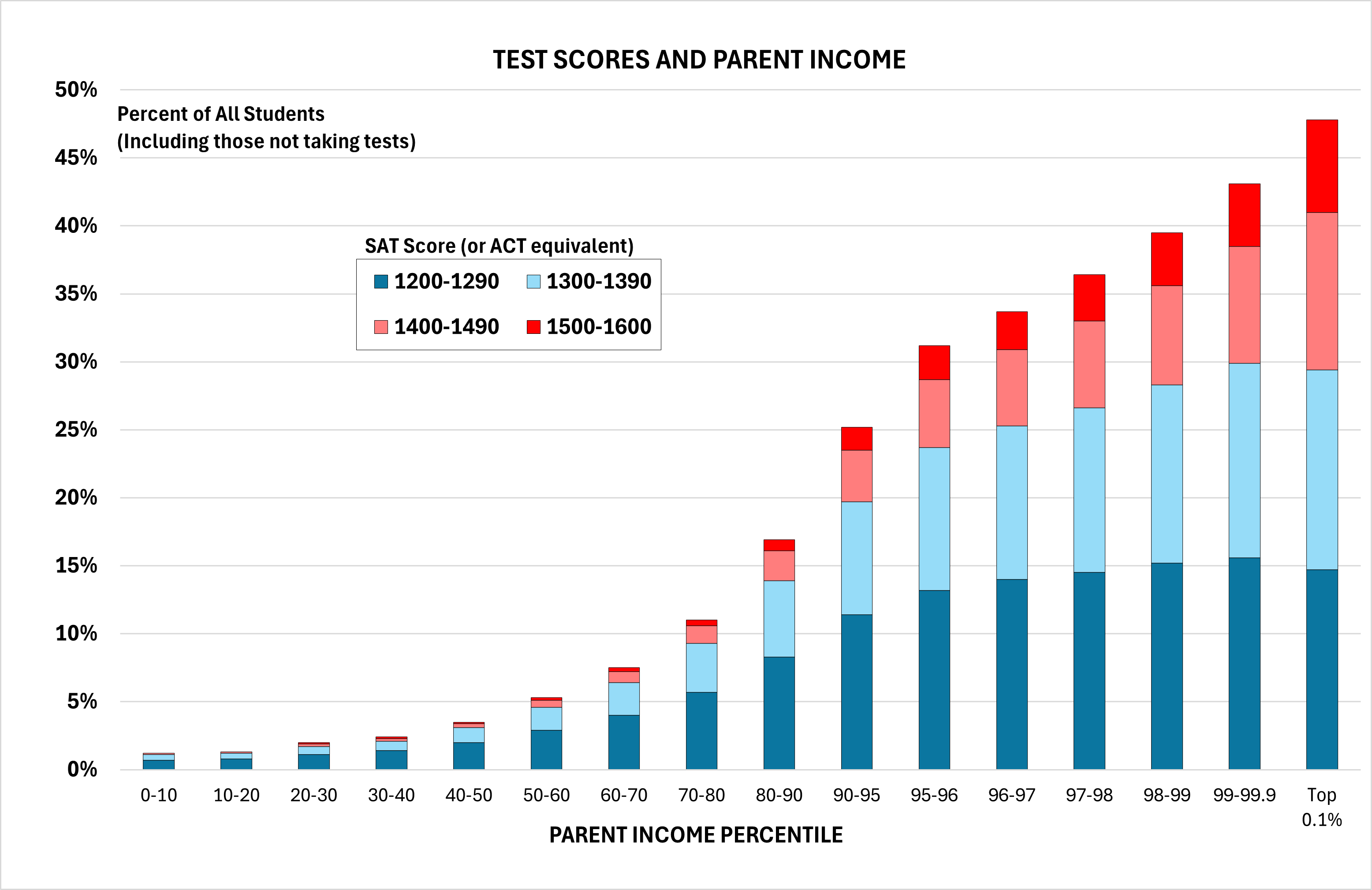
Explaining this skew demands its own essay, which I plan to write. For now, I will just say that wealthy children are often much better prepared for college than their peers. Test score results (see graph) provide the simplest window into this problem. Some critics see these results as evidence of bias in the tests, but they just want to shoot the messenger. The data mostly record the vast differences in educational investments made on behalf of students from different socioeconomic backgrounds. There are other processes like legacy and athletic preferences that increase inequality even more, especially at highly selective private institutions, but the core problem is the pipeline. The difficulty is compounded by the fact that the high level of qualification levels of the most advantaged students effectively raises the bar that all applicants must pass over. This makes it even harder for less advantaged students, who may not have had the opportunity to demonstrate their long-term promise, to stand out.5
Mostly, our response to unequal college access must be to improve and equalize K-12 educational outcomes,6 but action at the college level is possible as well. Elsewhere I have written about the tremendous class-based skew in college attendance and graduation rates and have presented a plan for developing much broader access to college. Given the complexity of our economy and the pace of technological change, almost everyone today would benefit from some post-secondary education, even if that’s not at a “traditional” four-year college, and probably needs lifetime access to education as they navigate a changing economy and society. This will not eliminate education-based income inequality. The value of a college degree has risen partly because the nature of work in America has changed.
Social Rights and The Problem of Advantage
If advantage is a fact of life we have to live with, and those with merit ought to earn an economic premium, how should we even think about equality of opportunity and the prospects for a more egalitarian society? The social citizenship approach argues that our main response to these issues should be to ensure that the least advantaged have access to the resources they need to fully participate in society.
A quick refresher: Social citizenship is about establishing an equality of status grounded in equal membership in the community. The proof of that equality is full participation in society. Every person must have life choices that are comparable to those enjoyed by everyone else and the capacity to choose among them. This formula provides a concrete definition for both freedom and equality of opportunity and a way to understand our duty to each person whom we claim is an equal member of our community. To be able to choose, we all need access to certain personal resources, most notably an adequate education; and we all must achieve a certain level of personal independence so that our choices are not dominated by others. If we are serious about guaranteeing that everyone has equal civil and political rights, we also must guarantee that people have access to the resources they need to fully exercise those rights; those are what social rights are. The politics of social citizenship consists in the argument about the set of life choices (opportunities) that we all should have and the sorts of resources they require.
I am describing a specific approach to the problem of material inequality. It promises only to set standards of adequacy regarding acceptable social minima across a set of basic goods. The aim is not equalization, except the equalizing effects that result from higher progressive taxation. Instead, the focus is on the capabilities of the least well positioned members of society, on getting everyone to the starting line with an adequate set of personal resources and capabilities.
Is that enough? No. The full response to inequality has to address problems associated with privilege, a distortion related to but different than advantage,7 and with the distortions created by extreme concentrations of economic power, the oligarchs. Those problems hinge on errors in formal legal structures and require institutional responses. Social rights, in contrast, deal with the ordinary economic relations of everyday life.
The argument for the efficacy of truly adequate social minima goes something like this: If people have achieved this level of social, economic, and political independence, then they will be able to express and defend their own private and public autonomy. This will give them the tools they need to shape society as a whole. Here, I want to quote myself:
While the larger public philosophy of civic republicanism often calls for other state structures to control private economic power and limit its excesses, in practice the minima set as social rights serve as the main check on private power. They support the capacity of individuals to confront, resist, protest, or exit private relations of domination. If we limit the number of people who are in a position to be dominated, that necessarily limits the damage economic inequality can cause.8
Next week, I will continue this essay to consider Sandel’s deeper claim that it is impossible to build real solidarity in a society based on merit. (18 November 2025)
<All of the posts (most anyway) in On Social Citizenship connect. I recommend that readers go back and read the first entry in the series.>
Notes
Michael Sandel, The Tyranny of Merit (Picador, 2020), 227.
Sandel, 161.
In their last “Education Pays” report, the College Board found that those holding (only) a Bachelor’s degree, on average, earned 65% more annually than those with only a high school diploma.
Raj Chetty, David Deming, John Friedman, “Diversifying Society’s Leaders? The Determinants and Causal Effects of Admission to Highly Selective Private Colleges”, Opportunity Insights, August 2025.
The focus of this paper is on explaining the advantages that students from very high-income families have in Ivy-Plus admissions (Ivy League plus MIT, Stanford, Chicago, and Duke). The title of the paper says why this is important—a disproportionate share of key leaders attend these institutions (71% of all Supreme Court Justices since 1967!)—but the Ivy+ group includes less than 1% of all college students.
We often forget the raising the bar effect—I think because we want to think that today’s students are somehow worse than we were when we were young. The opposite is true, especially at very selective schools.
See my discussions of K-12 education: Education for Freedom and Is There a Right to Education?
I have been working on the essay that explains the difference between advantage and privilege and why it matters for a while now. Eventually I will post it.
Stephen Minicucci, The Tools to Be Free (Lexington Books, 2024), 37.