
Solidarity
What unites us?


Post 42: 18 November 2025
Today, I want to continue the discussion I started last week about Michael Sandel’s thesis in The Tyranny of Merit.1 Besides the book, I am reacting to Sandel’s excellent lecture and the discussion that followed at the Radcliffe Institute on October 23 (video available here, Sandel begins speaking at 7:15).
Sandel claims that our over-reliance on “meritocracy” undermines our sense of solidarity, obscuring the public good in a sea of narrow private interests. Belief in merit has self-regarding and public consequences. In their own minds, people increasingly see themselves as solely responsible for their own success. They become blinkered to the social inputs that were essential to it and blind therefore to the public goods associated with those contributions. By the same logic, those who are not successful are responsible for their failures—for their poverty and prospects, as well as their illnesses and addictions.
Liberalism and Solidarity
It is difficult to imagine an idea more corrosive of empathy than this brand of individualism. In this world, there is no common cause between the rich and the poor. Social protections limit the freedoms of hardworking people but little benefit the idle. It is a vision of a society split between the doers and slackers. It’s not a new idea. In 1786, Joseph Townsend wrote in his “A Dissertation on the Poor Laws” that “The poor know little of the motives which stimulate the higher ranks to action—pride, honour, and ambition.”2 Townsend’s campaign against welfare as he knew it had the support of the most prominent economists of his age, most notably Jeremy Bentham. Its eventual success ushered in what I have labeled the “liberal moment”—an era of laissez-faire capitalism in the mid-19th century. Modern socialism and egalitarian forms of liberalism are both best seen as reactions to the unfettered capitalism of that era.
This legacy is still evident in what Sandel labels “free-market liberalism”.3 In the 20th century, its most important advocate was Friedrich Hayek, who argued that public efforts to ensure that everyone had “an equal start and the same prospects” required government interventions that would “be the opposite of freedom.”4 In the United States, interpretations of Hayek by economists like Milton Friedman and James Buchanan formed the core of Reagan’s neoliberalism. This is the world we live in today, the one to which Sandel reacts. While the core ideas are now centuries old, the neoliberal revival made the questions Sandel raises fresh again. We are now forty-plus years into the current expansion of market-based thinking, of which the “meritocracy” is only one manifestation. I don’t know if, or how, we can compare this liberal moment to the 1830s or the 1890s or the 1920s, but it is fair to say that the constellation of issues that it brings, especially the rise in inequality, is worse now than at any point in my lifetime.
Liberal reformers have been pushing back against this narrow individualistic liberal tradition for well over one-hundred years. The welfare state embedded in New Deal ideas ultimately arises from this reaction as well as the modern egalitarian ideas of writers like John Rawls.
Importantly, Sandel argues that the newer egalitarian liberal tradition is not truly responsive to the kinds of social divisions that come from market-based thinking, from meritocracy. Bringing people up to “an equal start”—which seems like the main practical point of social rights as I pitch them—is not enough. He has a point. We certainly want equality of opportunity, but we should not see “mobility” as “the answer to inequality.” That treats equality of opportunity as “a remedial principle.” Even if we could make the competition for economic and social rewards fair, one of my topics last week, structuring our rewards mainly on market-value will leave us divided. Instead, we have to create a system in which those who do not “rise” can “flourish in place”.
Sandel’s beef with what he calls “welfare state liberalism” is subtle here. I might set this up another way but generally agree with his conclusion. The argument is that welfare state programs, at least within a liberal welfare state like the United States,5 are compensatory. To an unnecessary extent, they provide abatements to those for whom market outcomes are insufficient. This makes these programs vulnerable to the claim that they are fundamentally about redistribution. That, Sandel says, “fails to provide a sense of community adequate to the solidarity it requires.” The social citizenship approach agrees with this conclusion: this should not be about redistribution, but about the minimum requirements of membership, something that we owe to everyone that is independent of the market-value of the individual claimant.
Three Models of Solidarity
If over-reliance on market-based thinking is corrosive of the sense of community, does that mean that liberalism cannot be the source of the solidarity that any society needs to thrive? It is worth taking a step back to consider that question. It’s an important one, really the first problem that any political community must solve. “We, the people”, the Constitution begins, but are we “a people”? What glue holds this all together? To approach this, I need to recall an earlier set of essays in this series in which I described “three political languages”.6 The public philosophies of liberalism, conservatism, and republicanism that I described there provide very different kinds of answers to the core problem of belonging.
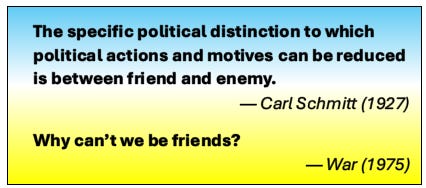
This is easiest for conservatives. Functionally, this is the problem that conservative thinking is designed to solve. Its central focus is on defining and defending community identity. Unfortunately, it does this, as Carl Schmitt wrote, by establishing who the enemy is.7 Our own identity is meaningful only in opposition to some “other”. The strength of the community bond, therefore, is forged only by denying any possibility of universalism and, as we have seen in this space, the principle of human equality.8 If the enemy is external, community feeling is fostered through nationalism, typically leading to international aggression. This, at least, leaves open the possibility of a unified nation. If the enemy is internal, solidarity is advanced through exclusion, oppression, persecution, and hate—by defining who is not a member of the community.
In both these scenarios, the activating mechanism involves the skillful nurturing of the perception of injury and a sense of superiority. Recently, the YouTuber Hank Green, somehow feeling the need to explain that racism is bad (yikes!), described it as “feeling superior to a group of people you are afraid of” (YouTube here).9 I make this sound bad because it is, but the people who fall for these manipulations are not necessarily “bad people”. They feel anxiety about losing status, economically or socially. They perceive cultural change as a threat to their own identity. It doesn’t feel like “their” community or country any more. Though these feelings are negative, they are natural. We can overcome them with information and integration, but conservative politicians instead exploit them for their own gain.
Liberals can’t go where conservatives do. Committed as they are to universalism and a pluralistic society, they cannot make appeals based on any one definition of American culture. As Rogers Smith explains, “They see all particularistic stories of national peoplehood as first steps down a slippery slope to intolerant chauvinism.”10 So in the face of the powerful emotional appeals made by conservatives, liberals offer only ideas. They are powerful ideas—that we are one another’s equals and that we all equally possess a set of rights rooted in our humanity—but these abstractions are weak tools with which to craft what Smith calls “stories of peoplehood”. Intellectual appeals lack the emotional punch of conservative identity narratives. It is hard to see how they can overcome the atomizing effect of liberal individualism.11
We try, however, in two ways. The first simply tries to unite us through our common belief in the liberal creed. This is America as an idea. One difficulty with this is that an uncomfortably large number of Americans do not subscribe to the traditional core of liberal principles; they are not fully committed to equality, to freedom of speech, due process, and so on. This is just a way of restating the problem: these “universal” principles have never applied universally, so they do not, by themselves, define who the “all” includes, who the “we” is. That is, the universal principles often apply only to members, and membership is what is being contested here.
A more dynamic version of a liberal unifying narrative focuses on progress in fulfilling the promise of the creed. This is an appealing story with motion and direction, a sense of a national project. Progress. The problem is that this “national” struggle is against the entrenched elites of the nation itself. There are bad guys in this story, and they are also Americans—indeed the very Americans who get to be the good guys in the conservative versions of the peoplehood narrative.
Civic republicanism, our third political language, focuses on the problem of self-government. It follows that republicans see participation in self-government, engaging in public life and the life of the community generally, as a critical part of what binds us together as a people. This is why republicanism defines virtue in public-facing terms, essentially as public spiritedness. This, I have noted elsewhere, is an unrealistic aspiration in an individualistic, liberal society. Still, we can draw useful lessons from the republican worldview.
My main takeaway is to focus more on action and less on ideas. Smith writes that “Allegiance should go less to a creed than to a shared endeavor.” This includes the shared acts of self-governance, certainly, but many private-minded Americans will only take occasional interest in the democratic process or the maintenance of democratic institutions. Still leaning on Rogers Smith, effective stories of peoplehood must make people feel like they are part of “a distinctive, ongoing collective endeavor”, one in which “people can imagine each other as fellow members of a collective enterprise.”
This formula, and it is a formula, suggests a number of possible courses of action, which we can approach from a society-wide or individual level. Especially at the social level, this is still often abstract, referring to the concept of self-governance or democracy. But the “endeavor” or “enterprise” to which Smith refers is also concrete. The community achieves, the nation builds. Building communities and infrastructure, curing disease, caring for one another, fighting fires and crime, national defense, and adapting to climate change are all collective accomplishments that we can all contribute to and participate in, just as everyone’s contributions were needed to win World War Two and everyone could take pride in the moon landings. The policy prescription this points to is simple enough: do stuff.
At the individual level, our sense that we are participants in a collective endeavor depends on our lived experience. Do we feel like we live in the same community as those associated with these accomplishments? More tangibly, are our lives similar enough to ensure that there are no insurmountable barriers to communication and cooperation? This is a big reason why inequality is so destructive. It erodes this sense of a common life. Traditional republicans always warned that inequality must be checked, even restricting the appearance of inequality when they could not check its substance. Today, there is a real risk that we have crossed whatever that limit of allowable inequality is, but assuming that is not the case there are things we can do to create more common experiences and more common spaces.
There are presumably a number of actions we could take along these lines, but one area is especially important to me. We should be taking action to create a common pathway from adolescence to adulthood. My preferred plan to do this is to establish a large-scale service-to-school program to ensure that almost all Americans have access to a post-secondary education. I introduced this plan in a series of two earlier essays posted at On Social Citizenship [“College Access as a Social Right” (Part I and Part II)] as well as in my book, The Tools to be Free. Participation in service and eroding the college/non-college divide will both help bolster our sense of a common life, just as universalizing high school education created a common American experience in the first half of the 20th century. Their effect would not only be psychological; people’s lifeways would be more similar than they are now, and we’d inch closer to sharing similar challenges and opportunities. Sandel says that the relative rewards to a college degree are too great so we should focus on ensuring that those without degrees can flourish. We should. But we should also do what we can so that everyone has a pathway to college regardless of the accidents of their birth.
Next week, TBD (25 November 2025)
<All of the posts in On Social Citizenship connect (today more than most). I recommend that readers go back and read the first entry in the series.>
Notes
Michael Sandel, The Tyranny of Merit (Picador, 2020).
Joseph Townsend, A Dissertation on the Poor Laws, Section III.
I typically label this set of ideas “traditional liberalism.”
Friederich Hayek, The Constitution of Liberty (Chicago, 1960), 92-93. This is a section of Hayek that Sandel quotes (126-127). To be clear, Hayek does not believe that we should assign any moral value to market outcomes. The primary value to him is freedom, and the reason we can’t do anything about market outcomes is that any intervention makes us less free. “Purist” followers (like Friedman) stick to this amoral or neutral line but most “conservative” politicians and writers moralize, happily echoing Townsend from more than two centuries before.
See my earlier discussion of “The Three Worlds of Welfare Capitalism.” Sandel does not make any claims, it seems to me, about social democratic or conservative welfare states; he is talking about America and its liberal welfare state.
The three political languages were introduced in essays from February 18 and February 19, 2025.
Carl Schmitt, The Concept of the Political (University of Chicago Press, 1996 [1927]). [Lyric in the text box is from War, “Why Can’t We Be Friends”, 1975.]
Hank Green, 11/15/25, quote at 10:33. Just an aside: Hank and his brother are national treasures.
Rogers Smith, That is Not Who We Are! (Yale 2020), 56. This is a splendid book.
See Smith, 52-60. The “progressive narrative” is well presented by Francis Fukuyama, Identity (Profile Books, 2018).